What we cover / TL;DR
- Most campus operations professionals have tried AI and been disappointed
- The problem is almost always the prompt, not the tool
- CREST is a five-element framework that changes outcomes immediately
- Role is the most skipped element and has the biggest impact on quality
- The skill gap is wider than the access gap right now
- The right platform meets teams where their data already lives
When was the last time you tried AI at work and actually got something you could use?
Not something you had to rewrite. Not something that sounded like it could have come from any institution anywhere. Something you looked at and thought: yes, this is exactly what I needed.
For most professionals exploring AI prompting for student housing and campus operations, that moment has not happened yet. And it is not because the tools are not good enough. It is because nobody taught them the part that actually matters.
At Campus Home Live 2026 in Orlando, Kinetic Software ran a live AI training session called The AI Quest. Forty-five minutes. Five real housing challenges. One fictional university called Rivendell University, located in Middle-earth, and dealing with a very stressful August.
The session was not about which AI tool to use. It was not about whether AI was going to replace housing staff. It was about one very specific and very fixable problem: most housing and campus operations professionals have tried AI, gotten mediocre results, and quietly decided it does not work for them.
They are wrong about the conclusion. But completely right about the experience.
The Access Problem Is Solved. The Skill Problem Is Not.
If you work in higher education right now, you almost certainly have access to at least one AI tool. ChatGPT, Microsoft Copilot, Claude, Google Gemini. The tools are everywhere. Many are free. Institutional licenses are being purchased across the country.
And yet, a significant majority of higher education staff still describe their current AI use as minimal or experimental. Institution-wide AI adoption rose from 49 percent in 2024 to 66 percent in 2025, but that number measures access and intention, not fluency. Owning a piano does not make you a pianist.
Before we introduced any framework at Campus Home Live, we asked participants one question: what is one task in your role that genuinely eats your time, where if you were ten times faster at it you would actually feel the relief?
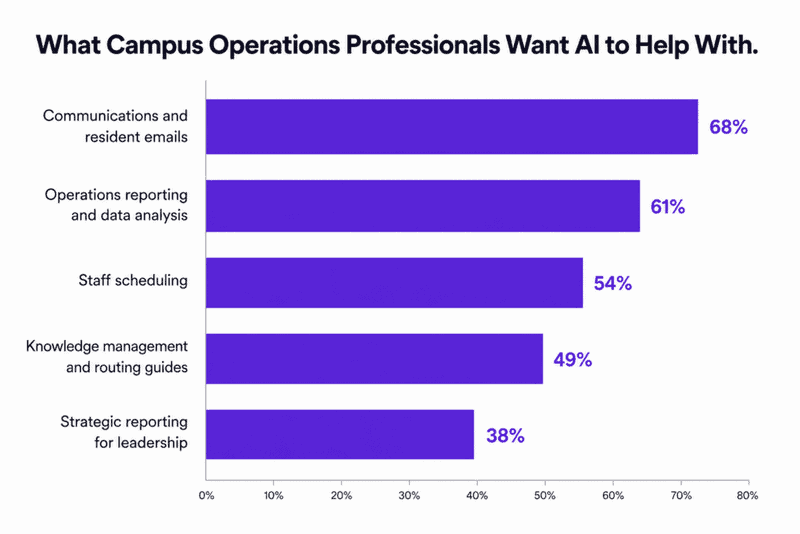
The answers were immediate and consistent: communication drafts, maintenance briefings, duty schedules, knowledge bases nobody can find, strategic reports nobody has time to pull together.
Every answer was an AI-solvable problem. The tools exist. The skills to use them are what is missing.
“
93 percent of higher education staff expect to expand their AI use for work over the next two years. The question is whether they have the prompting skills to make that expansion worthwhile.”
Source: Ellucian 2024 AI in Higher Education Survey
Why the Outputs Keep Disappointing
Here is what happens when most housing and campus operations professionals try AI for the first time.
They type something like “write an email about move-in day.” They get something back that is technically correct and completely useless. It could be from any university, for any student, about any process. It has nothing to do with their buildings, their dates, or the twelve things they know from experience that residents always get confused about.
So they close the tab. They tell a colleague. And the story becomes: AI does not work for us.
This is the wrong conclusion. Because nobody told them the part that matters: AI is only as specific as the instructions it receives. A vague prompt produces a vague output, every time.
Think of it this way. Imagine you hired the most capable new staff member imaginable. They can write, analyze, and summarize anything within seconds. They never call in sick. And on their first day you say: “Write an email about move-in.”
They write something generic. Because you gave them nothing to work with. Give them a role, an audience, a format, and a tone — suddenly the output is something you would actually send.
That is the entire lesson. It is not about the AI. It is about the prompt.
What CREST Is and Why It Works

The framework we introduced in the session is called CREST. Five elements. Each one adds a layer of specificity to a prompt, and each layer improves the output.
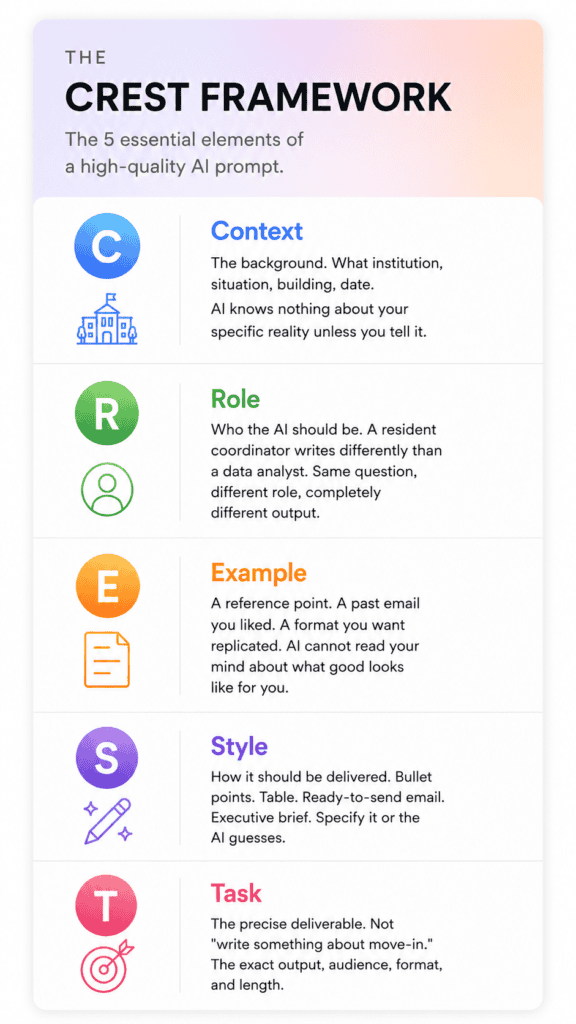
The more of these five elements you include, the better the output gets. The fewer you use, the more generic the result. Participants in the Campus Home Live session who used all five elements consistently produced outputs they rated as usable or near-sendable. Those who used two or three produced outputs they needed to significantly rewrite.
The Role Gap: Why One Missing Element Costs So Much
The single most consistent finding from the session was that student housing and campus operations professionals instinctively include a task and some context, but regularly skip the role.
When you assign a role, you are telling the AI what expertise to draw from, what perspective to write from, and what the implicit standards of quality are for the output. Without it, the AI defaults to a neutral, corporate-sounding middle ground that tends to feel generic and impersonal. Housing professionals recognize this in the output. They just cannot always name what is missing.
Here is a concrete example from the session.
Without Role
“Summarize the open maintenance tickets across our four buildings and identify the main patterns.”
Result
Competent but flat. Listed tickets by building. General observations. Required significant rewriting.
CREST Score:
4/10
With Role
You are a Housing Director preparing for Monday’s facilities meeting. Review all 23 open maintenance tickets and give me: the top three systemic patterns across buildings, a ranked list of buildings by urgency with specific ticket IDs, and three bullet points I can read aloud to start the meeting. Format as a briefing document.”
Result
Immediately usable. Named Maple Hall plumbing as critical priority. Flagged Cedar Tower HVAC as escalating risk. Ready to walk into the meeting with.
CREST Score:
8/10
Same data. The role changed everything.
This is why Role is the highest-leverage element in the CREST framework. It is also the one most people skip because it feels unnecessary. It is not.
What Good Prompting Actually Looks Like

Theory is one thing. Here is what CREST looks like applied to five real campus operations scenarios.
Move-In Email “You are a warm housing coordinator. Write a move-in email to first year students arriving August 16th at Oak Commons. Include: what to bring, check-in location, cart checkout, and the 15-minute unloading window. Tone: excited and welcoming. Format: complete email with subject line and sign-off.”
Maintenance Briefing “You are a Housing Director preparing for Monday’s facilities meeting. Give me: the three main patterns across tickets, a ranked urgency list by building, and three sentences I can read to open the meeting. Format as a one-page briefing.”
RA Duty Schedule “You are the Director of Residence Life. Build the September duty schedule for August 25 through September 21. Format: Date, Shift Type, RA Name, Building. Respect all constraints, apply Labor Day double coverage, flag any trade-offs. Make it fair.”
Knowledge Base “You are the Housing Director building a quick-reference guide for front desk staff. Using these templates and FAQs, create a one-page routing guide by situation type. For each: trigger phrase, template to use, what to verify. Usable by a new staff member on day one with zero training.”
Strategic Brief “You are preparing a five-minute briefing for your VP of Student Affairs. Using four years of occupancy data, three years of maintenance history, academic distribution by building, and this semester’s survey sentiment, give me three non-obvious insights standard reports would never surface. Format as an executive brief.”
Each of these takes about two minutes to write. Each produces an output that would have taken hours to produce manually.
According to Ellucian’s 2025 research, educators who completed structured AI productivity training reported saving two or more hours per week. For campus operations teams that are already stretched, those hours are the difference between reacting to problems and having time to prevent them.
The Conversation Does Not Have to Stop Here
The five challenges in The AI Quest were not invented. They came from real conversations with housing, residence life, and campus operations professionals across North America. Move-in communications that take too long. Maintenance data nobody has time to analyze. Schedules that eat half a workday. Knowledge that lives in one person’s head. Strategic questions that never get answered because the bandwidth was never there.
AI does not solve all of those problems automatically. But teams that learn to prompt well are finding that a significant portion of the work that used to pile up is suddenly manageable. Not because the work got easier. Because they got better at asking for help.
That is what The AI Quest was designed to do in 45 minutes. And it is what we think about every day at Kinetic Software: not what we want campus operations teams to buy, but what we want them to be able to do.
If anything in this piece resonated with challenges your team is facing right now, we would genuinely love to talk.
Let's talk about your challenges

Kinetic Software is a leader in on-campus student accommodation software, supporting housing departments in delivering smooth and efficient experiences for students and staff alike. With over 26 years of expertise, Kinetic is trusted by more than 340 institutions worldwide to manage 180 million bed-nights annually. Their software suite offers tools for everything from booking and leasing to communication and payment, allowing departments to operate at peak efficiency.
Supporting 350+ institutions across 20 countries, we respect your privacy and use your information to share relevant insights, products, and services. You may unsubscribe from these communications at any time. For more information, check out our Privacy Policy.