

What we cover / TL;DR
- Housing teams managing more requests with the same (or fewer) staff
- Manual workflows create compounding errors and delays
- Administrative simplification is now a top-10 higher ed priority
- Purpose-built tools let housing teams fix this without IT
Ask any housing director what their day looks like and they’ll tell you it’s rarely what they planned. Between the emails chasing missing information, the spreadsheets tracking who approved what, and the manual data entry that eats up hours no one budgeted for, there’s a whole layer of invisible work happening underneath the actual work of supporting students.
And it’s getting heavier. Enrollment is rising. Student expectations are higher. Staffing hasn’t kept up. The result is a housing team constantly in reactive mode, not because they’re not good at their jobs, but because the systems around them weren’t built for where operations are today.
Manual Processes: A Cost That Compounds Daily

The challenge isn’t any single form or any single request. It’s the way those things stack up across a semester. A maintenance request that arrives with missing information. A room change form that gets lost between inboxes. A workflow that requires three manual handoffs to reach the right person. Each one is manageable. But multiply it across hundreds of students and dozens of staff members, and you have an operational drag that quietly consumes your team’s capacity.
Research Snapshot
Where Housing Staff Time Goes

EDUCAUSE named administrative simplification a top-two strategic priority for higher education in 2025, calling out the need to move away from manual, paper-intensive processes toward platforms that support real workflow automation. This isn’t a fringe concern anymore. It’s showing up at the leadership level.
The Disconnect Between Forms, Data, and Action
Most housing teams aren’t short on forms. They have forms everywhere: in email, on Google Docs, in shared drives, on printed paper. The problem isn’t the absence of a process. It’s that those processes exist in silos that don’t talk to each other, and the connective tissue between them is your staff.
How It Looks In Practice
- A student submits a request with missing fields, so staff emails back to follow up
- The response comes in. Staff manually enters the data into your housing system
- The request needs approval from a second person, so another email chain begins
- The final outcome is recorded manually, somewhere, by someone
- A week later, no one can easily find what happened or who signed off
Every step in that chain is a potential delay, a potential error, and a pull on your team’s attention. The cumulative weight of this is real. EDUCAUSE identified administrative cost reduction as a top-five institutional priority, specifically calling out that streamlining processes and reducing manual work is now preferable to cutting academic programs when institutions need to find efficiencies. The implication is clear: the administrative drag your housing team feels every day is the same drag that leadership is being asked to solve at the institutional level.
Staff Are Burning Out, and It's Not Just a Hiring Problem

Higher education has faced a real staffing challenge over the past several years. But the conversation often centers on recruitment and retention when the deeper issue is workload design. When staff are spending the majority of their day managing process friction, following up, re-entering data, routing requests that should route themselves, they’re not just inefficient. They’re exhausted.
“
Higher education institutions are experiencing large numbers of employees leaving for more work-life balance and increased income, and the impacts include worker overload and burnout.
EDUCAUSE’s 2024 Trend Watch identified continued staff attrition and burnout as a defining challenge for institutions, with overloaded workers as a direct consequence of the gaps those departures leave behind. Housing teams operating on manual workflows are particularly exposed. When one person leaves, the process knowledge goes with them.
Impact Assessment
What Happens When Workflows Are Automated vs. Manual

The Real Cost Is Measured in Student Experience
There’s a version of this story that’s only about staff efficiency. But the ripple effect runs further than that. When a housing request takes three days to process because it’s traveling through a manual chain, a student is waiting on the other end of it. When a form arrives incomplete and triggers a back-and-forth, a student’s anxiety is sitting in that inbox too.
Today’s students have grown up with on-demand everything. The gap between their expectations and what a manual-process housing office can realistically deliver isn’t going away. It’s widening.
Teams that find ways to move requests faster, capture better information upfront, and eliminate the manual routing from routine workflows don’t just become more efficient. They become better at their actual job, which is supporting students.
The Bottleneck Isn't Your Team. It's What They're Working With.
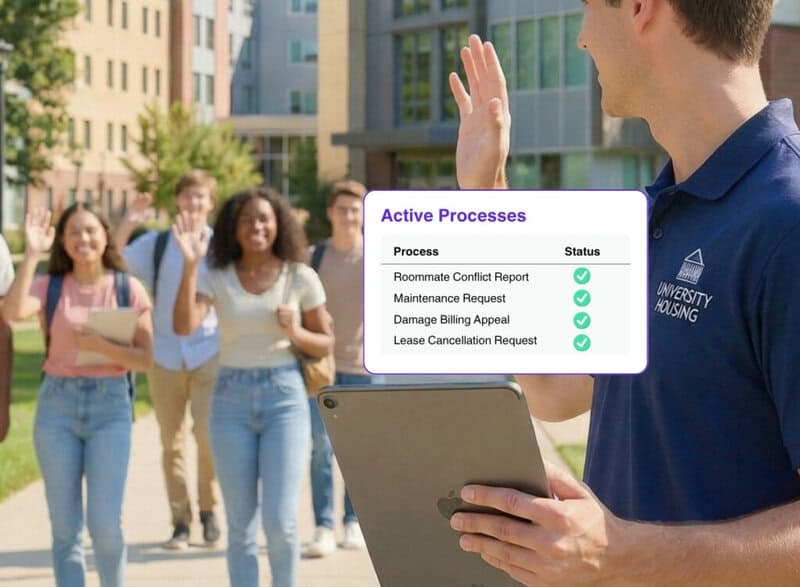
The housing professionals we’ve spoken with aren’t resistant to change. They want better processes. What slows them down is that the path to better processes has historically run through IT, with long timelines, competing priorities, and solutions that never quite fit the specific rhythms of how housing actually operates.
What changes the equation is giving operational teams the ability to build and own their workflows directly. When the people who understand the process are also the ones who can design, adjust, and maintain it, without waiting on a developer, the gap between the problem and the solution gets very small very fast.

The Next Evolution of
Custom Forms and Workflows
KxCreate is a custom forms and workflow platform built specifically for university housing teams, designed so your staff can build, automate, and manage processes directly inside KxWelcome, without any reliance on IT.
Custom Forms
Automated Routing
No IT Required
Centralized Data
Now in KxWelcome
Request a KxCreate Demo Today!
Supporting 350+ institutions across 20 countries, we respect your privacy and use your information to share relevant insights, products, and services. You may unsubscribe from these communications at any time. For more information, check out our Privacy Policy.